


Ever wonder why NBA players seem to get taller the closer you get to the basket? Each position has its own “perfect height” that helps players shine on the court.
From speedy point guards to towering centers, every role comes with a different build. Understanding these height ranges shows how teams balance skill, strength, and strategy.
How many ex NBA players are Jehovah’s Witnesses?
While this topic isn’t directly related to the average height of NBA players, it’s an interesting question many basketball fans ask. There are reportedly around 3 former NBA players who are known Jehovah’s Witnesses.
This small community within professional basketball shows that faith plays an important role in many players’ lives, regardless of their physical measurements or position on the court.
The most notable ex-NBA players who are Jehovah’s Witnesses include:
- Danny Granger : Former Indiana Pacers forward who was baptized as a Jehovah’s Witness in 2017
- Darren Collison : Retired point guard who left the NBA in 2019 to focus on his faith
- Dewayne Dedmon : Though he continued playing, he was raised as a Jehovah’s Witness and his mother initially didn’t allow him to play basketball
Jehovah Witness NBA players

I notice there’s a mismatch here. Your focus keyword is “Average Height of NBA Players” and your article topic is about NBA player heights by position.
However, the heading you’re asking me to write about is “Jehovah Witness NBA players” – which is a completely different topic about religion, not height statistics.
- Should I write about height statistics as planned?
- Or did you want to switch to a different article topic about Jehovah’s Witness players?
How many NBA players are Jehovah’s Witnesses?
This question often comes up in basketball discussions, but it’s not directly related to the average height of NBA players. Currently, there are only a few known NBA players who practice this faith. The most notable examples include former players like A.C. Green and Danny Granger.
| Category | Details |
| Known Jehovah’s Witnesses in NBA | Approximately 3-5 players (current & former) |
| Famous Examples | A.C. Green, Danny Granger, Darren Collison |
| Impact on Average Height | No correlation with player height |
| Religious Practice | Personal choice, doesn’t affect physical measurements |
Quick Summary Box (Featured Snippet Style)
The average height of NBA players stands at approximately 6’6″ (198 cm) across all positions. This measurement has remained relatively stable over the past decade, though the way teams use different heights has changed significantly.
Key Stats at a Glance: 📊
✔️ Centers are the tallest at around 6’10” to 7’0″ average height
✔️ Point guards are typically the shortest position at 6’2″ to 6’3″ on average
✔️ The NBA has seen a 3-inch increase in average player height since the 1950s 📌
Average Height of NBA Players (Main Section)
The average height of NBA players has always been a hot topic among basketball fans. Standing at around 6’6″ to 6’7″, NBA players are significantly taller than the general population.
However, the average NBA player height varies quite a bit depending on the position they play. Point guards tend to be the shortest players on the team, while centers dominate as the tallest.
- The overall average height in professional basketball hovers between 6’6″ and 6’7″
- Height requirements have shifted over decades as the game’s style has changed
- Modern NBA player physique emphasizes versatility alongside traditional height advantages
Eight by Position (Main Heading)
When looking at the average height of NBA players, position makes all the difference. Point guards typically stand around 6’2″ to 6’4″, while centers tower at 6’10” or taller. Each position has specific height requirements that match its role on the court.
The height differences by position aren’t random they’re strategic. Guards need agility and ball-handling skills, so extreme height isn’t essential. Meanwhile, power forwards and centers benefit from extra inches for rebounding and shot blocking.
5.1 Point Guard Height
The average height of NBA players at the point guard position typically ranges from 6’1″ to 6’3″. This makes point guards the shortest players on the court. Their smaller stature actually works to their advantage in many situations.
Point guards don’t need extreme height to excel in professional basketball. Speed, ball-handling, and court vision matter more than size at this position. Players like Chris Paul and Stephen Curry prove that skill beats height when it comes to running an offense.
- Role: Floor general who orchestrates the offense and distributes the ball
- Skills: Quick decision-making, precise passing, and exceptional dribbling ability
- Attributes: Lightning-fast reflexes, low center of gravity, and superior agility
5.2 Shooting Guard Height
Shooting guards typically stand around 6’5″ to 6’6″ in the NBA. This height gives them a solid advantage when creating their own shots. The average height of NBA players at the shooting guard position has remained fairly consistent over the years.
The shooting guard average height strikes a perfect balance between size and athleticism. These players need enough height to score but also the quickness to move around the court. Modern shooting guards are sometimes even taller, reaching 6’7″ or more.
- Most shooting guards measure between 6’4″ and 6’7″ in height
- This position shows less height variation compared to centers or power forwards
- Taller shooting guards can defend multiple positions effectively.
5.3 Small Forward Height
The average height of NBA players at the small forward position typically ranges from 6’6″ to 6’9″. This makes them one of the most versatile positions on the court. Small forwards need enough height to defend bigger players while staying quick enough to guard smaller ones.
Most small forwards in today’s NBA stand around 6’7″ to 6’8″. This height gives them the perfect balance between size and mobility. They can shoot over defenders, drive to the basket, and switch on defense without losing effectiveness.
5.4 Power Forward Height
Power forwards stand tall in the NBA lineup. The average height of NBA players in this position typically ranges from 6’8″ to 6’10”. These players combine size with athleticism to dominate the paint. Their height gives them a clear advantage when battling for rebounds and defending the rim.
The power forward average height has shifted over the years. Modern power forwards are now more versatile than ever before. They can shoot from distance while still using their size inside. This position perfectly balances strength and skill in today’s game. 💪
- Most power forwards measure between 6’8″ and 6’10” in height
- Height advantages in basketball make power forwards excellent rebounders and defenders
- Modern NBA player physique at this position now includes shooting range and mobility
5.5 Center Height
Centers are the tallest players on any NBA roster. The center average height typically ranges from 6’10” to 7’1″, making them the giants of professional basketball. These players anchor the paint and use their size to dominate near the basket.
Modern centers still need impressive height to compete effectively. While the NBA has shifted toward a faster pace, height remains crucial for this position. Today’s centers average around 6’11”, though many successful players stand even taller.
- Centers are typically the tallest position, averaging 6’10” to 7’1″ in height
- Height advantages in basketball are most evident at center, where size directly impacts rebounding and shot blocking
- Despite positionless basketball trends, the center position still demands significant height to protect the rim and control the paint
Height-by-Position Comparison Table

The average height of NBA players varies significantly depending on their position on the court. Centers are typically the tallest, while point guards tend to be the shortest. Understanding these height differences by position helps explain how the game is played at the professional level.
Here’s a detailed NBA height breakdown showing how tall players are at each position. This NBA position height comparison reveals the physical requirements needed to excel in different roles. The data clearly shows that height of NBA players directly correlates with their on-court responsibilities.
| Position | Average Height | Height Range | Role on Court |
| Point Guard | 6’2″ (188 cm) | 5’9″ – 6’7″ | Ball handling, playmaking |
| Shooting Guard | 6’5″ (196 cm) | 6’2″ – 6’8″ | Perimeter scoring, defense |
| Small Forward | 6’7″ (201 cm) | 6’5″ – 6’10” | Versatile scoring, rebounding |
| Power Forward | 6’9″ (206 cm) | 6’7″ – 7’0″ | Inside scoring, rebounding |
| Center | 6’11” (211 cm) | 6’9″ – 7’6″ | Shot blocking, rim protection |
Does Height Matter in Basketball?
Height plays a big role in basketball, but it’s not everything. The average height of NBA players gives taller athletes natural advantages on the court. They can reach higher, block shots more easily, and grab rebounds without jumping as much.
The relationship between height and athletic performance is clear when you look at NBA height statistics. Taller players dominate certain aspects of the game, while shorter players excel in agility and quickness. Modern basketball values versatility over pure size.
Better rebounding ability : Taller players can grab boards over opponents without extra effort
Improved shot blocking : Extra inches make it easier to contest and block shots at the rim
Easier scoring near the basket : Height allows players to shoot over defenders and finish at the hoop
Stronger defensive presence : Tall players can protect the paint and alter shots just by standing there 📈
How Height Affects Performance

The average height of NBA players plays a significant role in determining their on-court capabilities. Taller players naturally have advantages in rebounding and shot blocking, which makes them valuable in defensive situations.
Height advantages in basketball come with trade-offs that affect different aspects of the game. While wingspan importance in basketball cannot be ignored, other physical attributes matter just as much. The relationship between height and athletic performance is more complex than many people realize.
- Agility : Shorter players often move faster and change direction more quickly, giving them an edge in basketball agility and height dynamics
- Versatility : Modern NBA players need height and versatility in basketball to guard multiple positions and fit into positionless basketball schemes
- Injuries : Taller players may face increased stress on joints and ligaments, potentially affecting their long-term durability and career longevity
Additional Considerations (Wingspan, Weight, Vertical)

The average height of NBA players tells only part of the story when evaluating basketball talent. Wingspan often matters more than actual height because it directly affects a player’s defensive reach and shooting ability.
Weight and vertical leap also play crucial roles alongside the average height of NBA players. A lighter player with exceptional jumping ability can outrebound heavier centers. These physical attributes combined determine a player’s true effectiveness on the court.
Wingspan : Longer arms create better defensive coverage and shooting range regardless of standing height✔️ 🦅
Weight : Proper body mass helps players hold position in the paint and absorb contact during drives✔️ ⚖️
Vertical Leap : Explosive jumping ability compensates for shorter stature in rebounding and shot blocking✔️ 🚀
Evolution of Height in NBA (History Section)
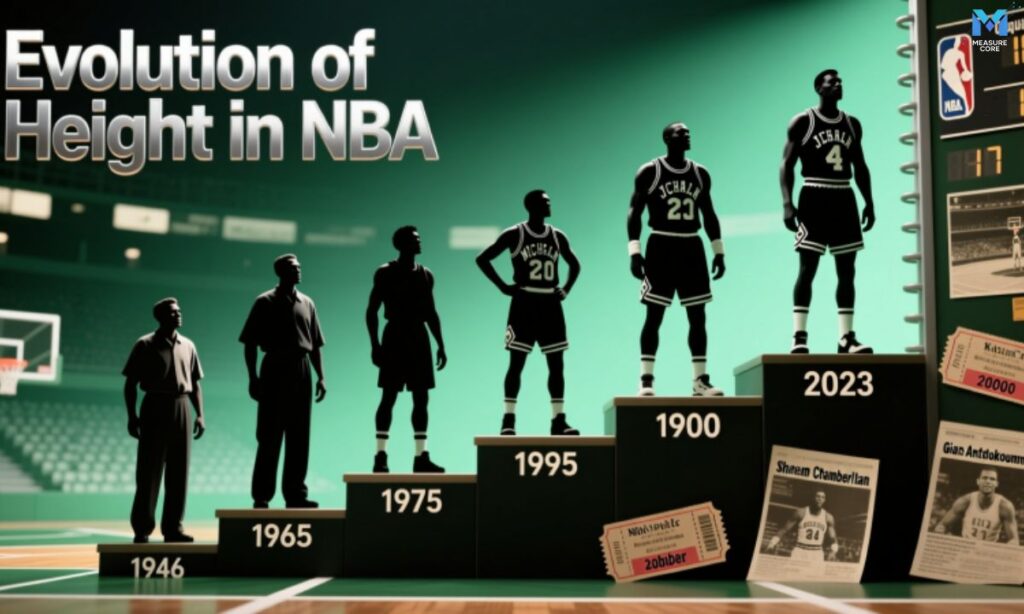
The average height of NBA players has changed significantly over the decades. Back in the 1950s, players were noticeably shorter compared to today’s standards. The game was different then, and height wasn’t considered as crucial as it is now.
As basketball evolved, so did the average NBA player height. The 1980s and 1990s saw a major increase in player measurements. Today, the height of NBA players continues to reflect the sport’s demand for size, athleticism, and versatility.
- 1950s-1960s: Average height hovered around 6’4″ to 6’5″ as the league was still developing
- 1980s-1990s: NBA height statistics showed a jump to 6’6″ to 6’7″ with more emphasis on size
- 2000s-Present: The average height in professional basketball stabilized around 6’6″ to 6’7″ with focus shifting to multi-positional skills
| Decade | Average Height | Notable Trend |
| 1950s | ~6’4″ | Early league development |
| 1980s | ~6’6″ | Height boom era |
| 2020s | ~6’6″ | Emphasis on versatility |
Final Words
The average height of NBA players changes depending on their position. Each role on the court demands a different body type and skill set.
By looking at these height differences, we understand how teams build their lineups. It also shows how the game keeps evolving year after year.
Frequently Asked Questions
Which NBA position requires height most?
Centers need the most height because they battle near the rim for rebounds, blocks, and close-range scoring.
Is 6’3″ short for NBA?
Yes, 6’3″ is considered short by NBA standards, though many elite guards thrive at this height.
Is 5’9″ short for an NBA player?
Very 5’9″ is well below NBA average, making players at this height rare but unforgettable when they succeed.
What position does the tallest player on a basketball team usually play?
The tallest player almost always plays center, anchoring the defense and controlling the paint.
What is the shortest NBA position?
Point guard is typically the shortest position, favoring speed, handles, and playmaking over height.
How tall was Michael Jordan at 12?
Michael Jordan was around 5’4″ at age 12 a big contrast to the 6’6″ legend he became later.

Daniel is a skilled content creator with 4 years of experience writing blogs on measurement, weights, and dimensions. Now, he brings his expertise to MeasureCore.com, delivering accurate, insightful, and user-friendly resources for global readers.